Gök Medrese — the “Sky Madrasa” with turquoise minarets in Sivas
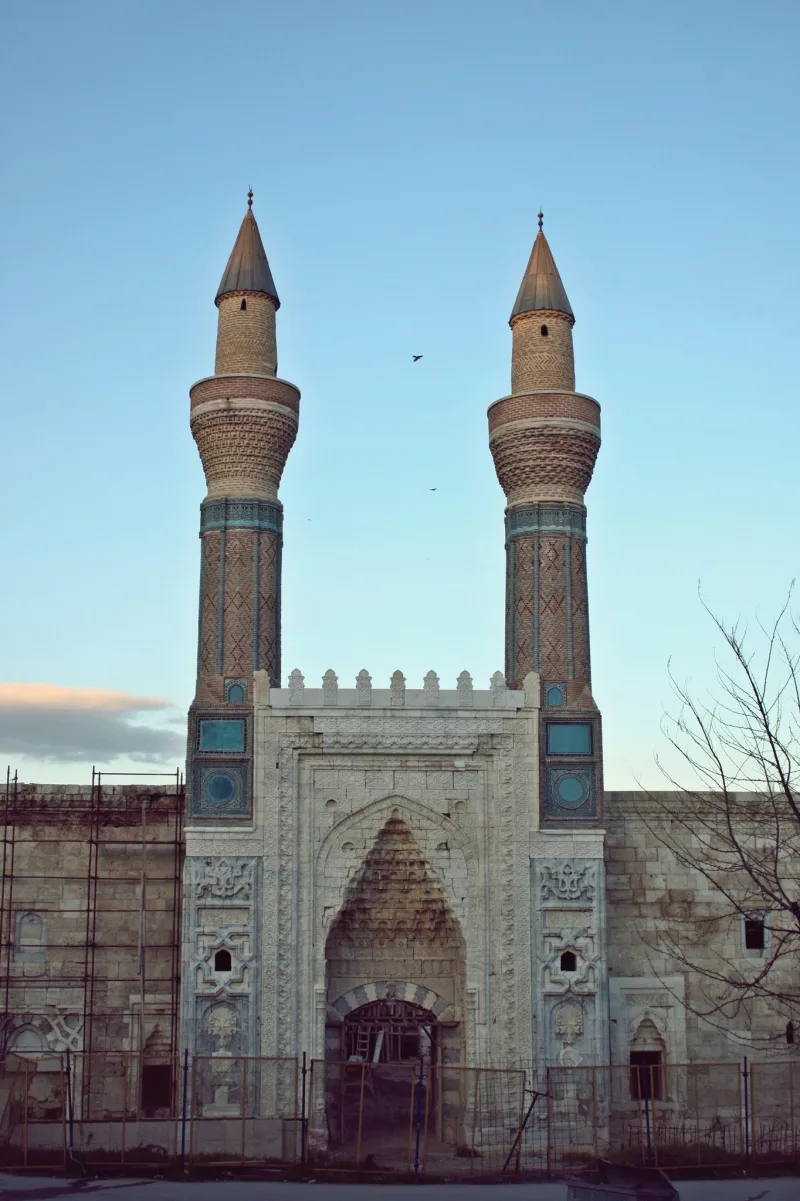
The name speaks for itself: Gök Medrese (Turkish for “Sky Madrasa” or “Blue Madrasa”) got its name from the turquoise tiles that once covered its facade. Today the tiles have faded, but the two 25-meter minarets flanking the monumental portal still rise into the Anatolian sky, setting the tone for the entire historic center of Sivas. The Gök Medrese, also known as the Sahibiye Medrese, was built in 1271 by order of Sahib Ati Fahreddin Ali—vizier and de facto ruler of the Konya Seljuk Sultanate. It is one of the largest and most impressive monuments of Seljuk architecture in Anatolia, and, like the neighboring Buruji and Çifte Minareli madrasas, it is a candidate for inclusion on the UNESCO World Heritage List.
History and Origin of the Gök Madrasa
1271, Sivas. The Konya Seljuk Sultanate is crumbling under Mongol pressure, but construction continues in the cities. The main patron of new buildings in Anatolia was Sahib Ata Fahreddin Ali—a man who had long governed the sultanate alongside the powerful vizier Perwane, and after Perwane’s death in 1277, concentrated actual power in his own hands. Sahib Ata was a patron of architecture, a benefactor, and a builder: several madrasas, mosques, and khans throughout Anatolia bear his name. The Gök Madrasa is the most grandiose of them all.
The project was designed by an architect known as Kaloyan of Konya—his signature has been preserved on the side column capitals of the portal. The name “Kaloyan” (Greek for “Good John”) suggests the master’s possible Armenian or Cappadocian Greek origin—a typical situation in Seljuk architecture, where the labor and talent of masters from different ethnic groups and faiths were united under the single patronage of the Muslim elite.
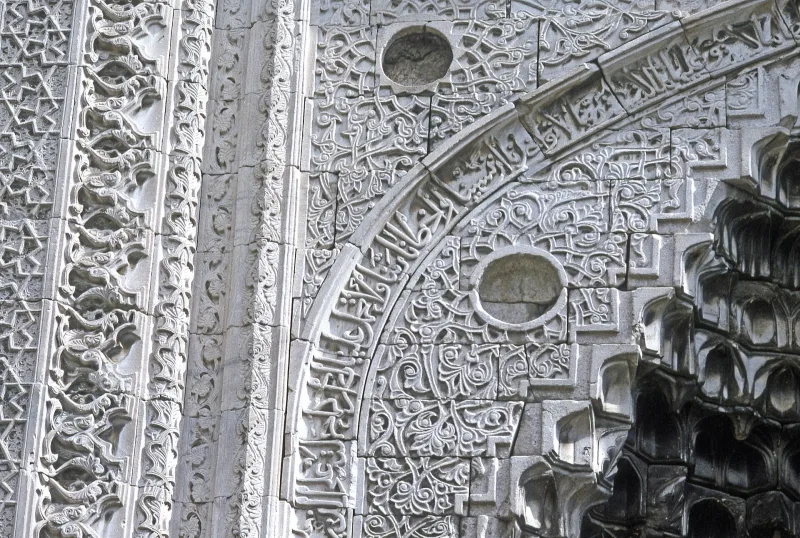
An Arabic inscription is carved on the madrasa’s portal: “Built during the reign of the great sultan, the greatest of kings, the helper of peace and faith, Kaykhusrev, son of Qilyq-Arslan. May Allah strengthen his realm.” The year is 1271. The inscription dates the monument and identifies the official suzerain under whom it was erected: Sultan Giyaseddin Kaykhusrev III.
The madrasa was used for its intended purpose—as an educational institution—until 1926, when the traditional madrasa system was abolished in the Republic of Turkey. After many years of neglect, the building underwent restoration in 1823. Originally, it was a two-story building with a hammam and a dining hall for 30 people; today, only 13 rooms on the ground floor remain—the mezzanine has been lost.
The madrasa’s waqf estate was impressive in scale: according to its founding document, its upkeep was funded by revenues from 85 markets, nine villages, two farms, and other sources. This indicates that the Gök Madrasa was not an ordinary educational building, but a major economic and spiritual institution. In 2014, it was nominated, along with other Sivas madrasas, as a candidate for inclusion on the UNESCO World Heritage List.
Architecture and What to See
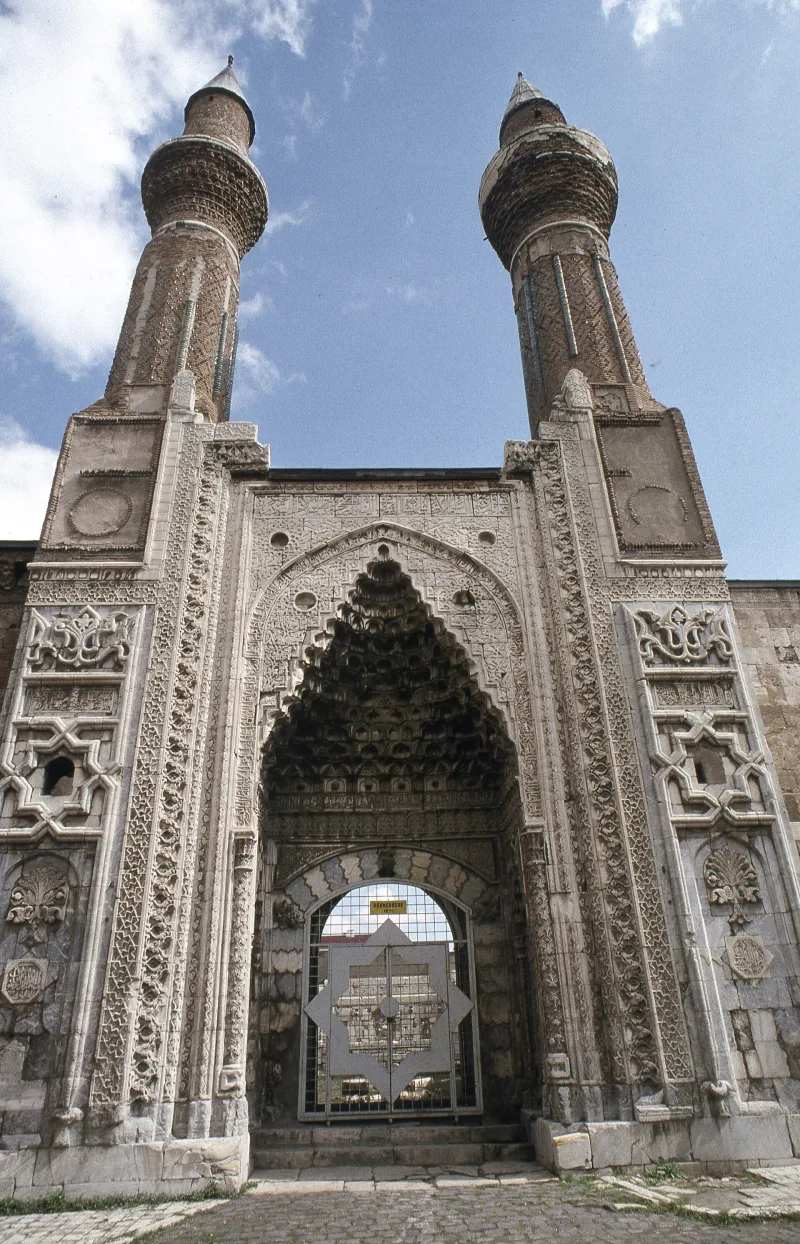
The Gök Medrese is a monumental structure. The building is 31.25 meters wide. The inner courtyard measures 24.25 by 14.40 meters. Two minarets, each 25 meters high, flank the main portal, creating a vertical accent visible from a great distance.
Main Portal
The portal is the main artistic highlight of the Gök Medrese. It is richly adorned with carvings and inscriptions in the finest traditions of Seljuk “stone carving,” yet remains harmonious: muqarnas above the entrance arch, lace-like arabesques on the side surfaces, and stalactite niches. The capitals of the pylons on either side of the portal bear the architect’s signature—a rare occurrence in medieval Anatolian architecture. It is on these capitals that the name “Kaloyan of Konya” is inscribed.
Two Minarets
The pair of minarets, each 25 meters high, dominates the entire complex. They are decorated with tiles (the historic turquoise ones that gave the madrasa its name) and carved ornamentation. Today, part of the tile cladding has been lost, but the shape and proportions remain intact. The minarets are topped with domes featuring traditional Seljuk details.
Inner Courtyard and Rooms
Beyond the portal lies a courtyard surrounded by arcades. Two main wings extend from the courtyard: one leads to the mosque (prayer hall), the other to the classrooms. The 13 surviving rooms on the ground floor provide a glimpse of the original layout. It should be noted that, unlike the neighboring Buruji Madrasa, there is no richly tiled mausoleum here, but the architectural grandeur more than compensates for this.
Comparison with other madrasas in Sivas
The Gök Medrese is part of a cultural cluster: nearby stand the Çifte Minareli Medrese (Two-Minaret Medrese, dating from 1271) and the Şifaiye Medresesi (hospital medrese, 1217). All three are located near the city square Kent Meydanı and can easily be visited on foot in a single day. For a complete comparison: the Çifte Minareli portal is more ornate, while the Buruciye is more austere and symmetrical. The Gök Medrese occupies a middle ground—grand in scale with refined, yet not “over-the-top” decoration.
Interesting Facts and Legends
- Architect Kaloyan of Konya is one of the few documented figures among the builders of Seljuk Anatolia. His signature on the portal capitals allows this monument to be attributed to him; the master’s possible Greek-Armenian origins speak to the cultural diversity of Anatolian craft traditions of the era.
- The waqf estate of the Gök Medrese included 85 markets and 9 villages. This was a vast economic base, comparable to the resources of an entire province. It provided salaries for the staff, maintenance of the building, and, apparently, food for the students.
- The name “Gök Medrese” has two meanings: “Heavenly”—in the sense of lofty, spiritual—and “Blue”—referring to the color of the turquoise tiles. In Turkish, “gök” means both “sky” and “blue.”
- The Gök Medrese functioned as an educational institution from 1271 to 1926—that is, for more than six hundred years without interruption. Even during periods of instability, it continued to fulfill its educational function.
- Together with the Buruciye Madrasa and the Çifte Minareli Madrasa, it was submitted to UNESCO in 2014 as a single historic cultural quarter of Sivas. A potential World Heritage site—which underscores the universal significance of the entire complex.
How to get there
The Gök Madrasa is located in the center of Sivas, on the city square next to other historic madrasas. The nearest airport is Sivas Nuri Demirağ (VAS), which receives flights from Istanbul and Ankara. The flight time from Istanbul is about 1 hour and 20 minutes. From the airport to the city center, take a taxi or city bus (15–20 minutes).
From Ankara, the TCDD train takes about 5–6 hours. Buses (Metro, Kamil Koç) run daily from Ankara and Istanbul. In Sivas, the madrasa is located in the historic center; all three monuments on Kent Meydanı are within walking distance. Admission is usually free (check on site).
Tips for travelers
Plan half a day for Sivas’s historic center: the Gök Madrasa, the Buruciye Madrasa, the Çifte Minareli Madrasa, and the 12th-century Ulu Camii Mosque—all within a 500-meter radius. The best time to photograph the portal is in the morning, when the sun shines from the east and highlights the relief of the muqarnas. Evening lighting is softer but lacks sharp detail.
The most vibrant time to visit Sivas is late August, when the city hosts the Culture and Arts Festival. The madrasas are illuminated, and concerts and exhibitions take place right in the courtyards. The rest of the time, the city is quiet and unassuming—which is precisely what makes a stroll through the historic quarter so pleasant: there are no crowds of tourists. Combine your trip with Divriği (the Ulu Camii mosque with its UNESCO-listed portal, 120 km to the east)—both sites make up a rich two-day “Seljuk Central Anatolia” itinerary. It is precisely the monumentality of the portal and the history of the outstanding vizier-architect that make the Gök Medrese a key stop for anyone studying the architecture of medieval Anatolia.